
Writing and 2x4s
On writer's guilt, framing hammers, and the satisfaction of creating something that lasts.

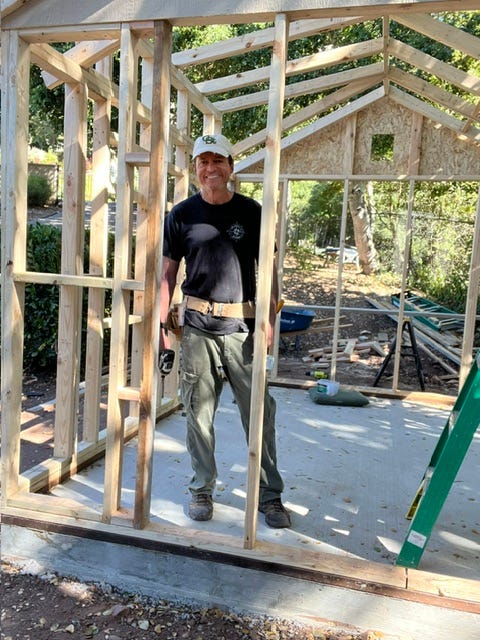
I’ve strung together a lot of words over my long career as a journalist, screenwriter, and, more recently, novelist. It would not be hyperbole to say that several million sentences have appeared in print under my name, though how many specifically would be anyone’s guess.
In truth, there have been few sentences I ever constructed that I reread weeks, months, or years later and didn’t cringe at, at least a little. Anyone who takes the craft of writing seriously knows their work can nearly always be improved with one more draft, tighter and more precise prose, more polishing. The problem is that once your sentences appear in a newspaper, magazine, or book, they’re out there for all the universe to judge, and there’s really nothing you can do to make what you’ve written better, even though you wish you could.
Why I Prefer Building Things
It’s why I have always enjoyed building actual stuff with my own two hands.
To construct anything of substance requires commitment, precision, and attention to detail. Certainly, crafting a novel is not that different. But in construction, unlike writing, there is no tinkering after the fact, no wishing for a second draft or a third. There’s permanence in the end result.
My love of working with my hands began long before my love of stringing together sentences. I was about five when my dad, a street cop who liked carving custom gunstocks in his off-time, began letting me play with his many handsaws, chisels, and files. In elementary school, I often doodled sketches of what my own workbench might look like one day, and where each tool would go.
When I graduated high school, I’d done well enough academically that my classmates voted me “Most Likely to Succeed.” What none of them knew was that my favorite class was woodshop, where I built what may have been the most rickety, unlevel, free-standing bookshelf ever made. I’d like to think my skills have improved since then through practice, persistence, and plenty of trial and error.
You might ask, “Well, if you enjoy building things so much, why didn’t you do it for a living?”
Two reasons, both of which I learned the hard way during brief stints as a teenager toiling on crews installing chain-link fencing and pouring cement driveways.
The first lesson is that—big surprise—physical labor is hard work. You bake in the summer and freeze in winter, and every day your body takes a beating. The second reason is that many of the people who hire you don’t appreciate the grueling demands of the job. They complain about the slightest imperfection, second-guess every decision, and grind you for every nickel. Life is too short. Such folks are best avoided.
The Cabin That Never Was
After I graduated from college, I dreamed of spending a summer building a kit cabin in Colorado, where I grew up. I would buy a beautiful plot of land high in the mountains and have the kit trucked in, sleeping at night in a tent among the pines while spending my days assembling my log retreat.
Then then I got married.
My bride, a city girl, wasn’t too crazy about the idea of spending months sleeping on the ground in a sleeping bag. Neither was my lower back, if I’m being completely honest. The fantasy of a cabin in the woods soon faded and we eventually settled in beautiful Santa Barbara. It was there that another construction fantasy took root.
I would build a home gym! Not that I didn’t have plenty of other work to do.
At the time, I was supposed to be finishing The Impossible Turn, my eighth Cordell Logan mystery, which is scheduled for publication next April. Every hour spent measuring rafters, hanging drywall, or making yet another trip to the hardware store was an hour not spent at my desk.
I was keenly aware of that fact.
The Writer’s Guilt Trap
Like many scribblers of words, I’ve spent much of my life carrying around a low-grade case of writer’s guilt. No matter how much I have accomplished on a given day, there is always the nagging sense that I should be producing more pages, revising one more chapter, or getting a little further ahead on the next book.
The feeling hasn’t disappeared entirely. I still wrestle with it. But age has a way of changing your perspective. Somewhere along the line, I began to understand that a life can’t be measured solely by word count. There are seasons for writing and seasons for other things. Sometimes the smartest thing a writer can do is step away from the keyboard for a while and build something, fly somewhere, spend time with family, or simply enjoy a beautiful day before it slips away.
I wish I could tell you I experienced that epiphany while building my gym. I didn’t. More than once, I found myself standing inside the half-finished structure wondering whether I should be pounding nails or sitting at a keyboard. The sensible answer was probably the keyboard. The problem was that my framing hammer kept winning the argument.
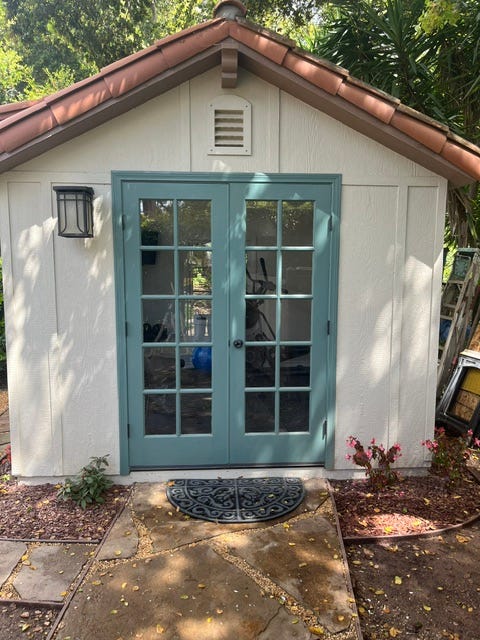
In any case, what began as a patch of unused backyard came to has since become a small cottage that now serves as our personal fitness center. It has French doors, plenty of windows, and enough exercise equipment to convince visitors that I am far more dedicated to working out than the available evidence might suggest.
Why Making Things Matters
The finished structure turned out great and pleases me, certainly. What interests me more, however, is why I enjoyed building it so much in the first place.
For much of my professional life, I have created things that exist only in the imagination. Newspaper stories disappear with the next news cycle. Screenplays often never get produced. Even novels, which have longer shelf lives, exist primarily in the minds of readers. Their value is real but ephemeral.
Constructing something with cement and wood, screws and nails, is different. It exists in the physical world, indifferent to anyone’s opinion of it.
There is satisfaction in that kind of certainty.
Words, 2x4s, and Perspective
Building the gym also helped me gain a healthier perspective on the work I wasn’t doing. I came to realize that neither was competing with the other.
The characters in The Impossible Turn didn’t go anywhere while waiting for me to finish the gym. The manuscript didn’t vanish. When the last sheet of drywall was hung and the final coat of paint had dried, the book was still there.
Maybe that’s one of the lessons age teaches if we’re willing to learn it. Life isn’t an either-or proposition. It isn’t work or family, writing or flying, building things or telling stories. The goal isn’t to choose one at the expense of everything else. The goal is to find room for all of it.
The Satisfaction of Creation
For reasons I still don’t entirely understand, I’ve always been happiest when making things. Sometimes that thing is a novel. Sometimes that thing is a home gym. The tools change. The satisfaction doesn’t.
In the end, whether I’m working with words or 2x4s, the impulse is exactly the same: to turn a pile of raw materials into something worth keeping.
I suppose that’s what I’ve been trying to do all along.
Ah yes, life measured by the word count. I hink I've finally come to terms with the idea of passing the baton to the others who still burn to finish the race. Thanks for your fine writing.