
Write It Down
Why inspiration rarely waits for a convenient moment.

A few nights ago, I awoke from a sound sleep at about half past three with a brilliant idea for my next Substack post.
I remember opening my eyes and thinking, This thing is so good it will write itself. It was one of those ideas that seemed so clever and obvious I couldn’t imagine how I hadn’t thought of it before. I lay there admiring my own genius. Unfortunately, I was also warm, comfortable, and only marginally conscious.
I briefly considered reaching for my phone to jot down a note that would capture the idea, but I didn’t want to disturb my wife or, for that matter, one of my dogs who was curled against my legs, snoring. Instead, I negotiated with myself. You’ll remember it in the morning. There’s no way you’ll forget something so fantastic!
Then morning arrived.
My amazing idea did not. It had vanished before dawn into the ether, and try as I might, I could not remember what it was.
Which, ironically enough, turned out to be a pretty good idea for a Substack post.
Inspiration Doesn’t Keep Office Hours
One of the things I’ve learned after years as a journalist, screenwriter, novelist, and teacher is that inspiration has terrible timing. Creative ideas don’t politely wait until you’re sitting down at your desk with a fresh cup of coffee. They barge into your life while you’re standing in line at the grocery store, perusing social media, washing the car, or lying awake at three in the morning when you should be sleeping.
Taking a hot shower, in particular, is among my most inspirational activities.
More than once I’ve stepped out convinced I’d just solved a plot problem that had been nagging me for days or stumbled onto the perfect opening paragraph for an essay. Experience has taught me not to trust my memory. I grab my phone immediately—sometimes while I’m still dripping wet—and dictate a note before I even reach for a towel. It makes for a damp bathroom floor but, hey, that’s a small price to pay. If I tell myself I’ll remember the idea after I dry off, there’s a very good chance it will have vanished by the time I’ve brushed my teeth.
As it turns out, I’m hardly alone.
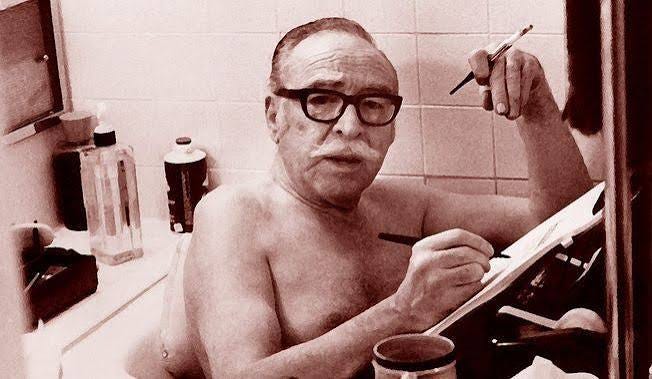
Academy Award winning screenwriter and acclaimed novelist Dalton Trumbo did some of his finest work in the bathtub. Rather than fighting his own creative process, he embraced it. He famously built a wooden platform that stretched across the tub, balanced his notebook on top, and spent hours soaking in warm water while chain smoking cigarettes and crafting prose, prune skin be damned.
Some people would call that eccentric.
Trumbo called it productive.
Every writer needs their own creative space to achieve the magic of spontaneous serendipity that is a cornerstone of the craft.
The One Place Ideas Never Find Me
Curiously, there’s one place where writing ideas almost never come to me.
The cockpit of my airplane.
People often assume flying must be a wonderful time to dream up stories. They picture me cruising serenely above the California coastline, mentally outlining the next Cordell Logan novel.
The truth is almost exactly the opposite.

Flying an airplane requires complete concentration. I’m monitoring engine instruments, talking to air traffic control, scanning constantly for traffic, watching the weather, managing fuel, navigating, and always asking myself what happens if something goes wrong. There simply isn’t enough mental bandwidth left over to wonder how Logan should get himself out of his latest predicament. I find that reassuring.
When I’m flying, I’m flying.
My writing brain takes a vacation. The ideas wait until after I’ve landed. They usually show up somewhere between putting the plane back in the hangar and getting home. Or in the shower that evening. Or while walking the dogs the next morning.
Three Words That Changed Everything
One of the most important ideas of my writing career arrived during one of those walks.
Years ago, when I was writing screenplays full-time, I had become increasingly frustrated with Hollywood’s reception to one particular script. I’d convinced myself that if only one executive would recognize its brilliance, everything would finally fall into place. Hollywood, as it often does, had other plans.
Feeling more than a little sorry for myself, I headed out for a long walk with the dogs.
I don’t remember where we were going or even what the weather was like. What I do remember as my pups tugged me enthusiastically along the sidewalk like chariot horses in Ben-Hur is looking down at my feet. A thought popped into my head:
I can walk.
Suddenly I realized how fortunate I was. Here I was feeling sorry for myself over some silly screenplay when there were millions of people in the world confined to wheelchairs who would’ve gladly have traded places with me in an instant. I could walk. I could breathe. My eyes and ears worked. I had family, friends, and every reason to believe life was pretty good.
By the time I got home, those three words—I can walk--had grown into something much larger.
What if I wrote a nonfiction book about gratitude? Not the Hallmark greeting-card version, but gratitude born from genuine hardship. What could the rest of us learn from people who had endured circumstances the rest of us could scarcely imagine? I put together a proposal and began interviewing remarkable people.
A concentration camp survivor.
A man living with late-stage Lou Gehrig’s disease.
A couple who had survived for weeks adrift in a tiny life raft after their boat sank at sea.
Each had endured unimaginable hardships. Each had also learned to appreciate life’s smallest blessings in ways most of us take for granted.
The proposal ultimately never sold--not as a book, anyway.
What it did sell was me.
A literary agent liked the proposal enough to offer representation. Although she never found a publisher for that particular project, our relationship continued. Before long, that same agent sold my first Cordell Logan novel.
Looking back, it’s astonishing to think that my mystery-writing career owes at least a small debt to a random thought that occurred while walking the dogs.
Catch Them Before They’re Gone
That’s why I write ideas down.
Journalists learn early in their careers that memory is a wonderful storyteller but a terrible filing cabinet. If something matters, you write it down. The same is true of raw ideas.
Most will never amount to much. Some seem brilliant at three in the morning and hopelessly mediocre after breakfast. Others disappear before you’ve even finished the sentence. But every so often, one tiny observation—a sentence scribbled into a notebook, a voice memo recorded at a stoplight, a thought captured while standing barefoot on a wet bathroom floor--changes the direction of your life.
Ideas are fragile things. They arrive without warning, stay only briefly, and disappear just as quickly if ignored. Which brings me back to that brilliant idea I had at three o’clock the other morning.
I still haven’t the faintest notion what it was. Maybe it would have become my favorite Substack post. Maybe it was complete nonsense.
I’ll never know.
But what I do know is this: the next time inspiration decides to wake me up in the middle of the night, I’m not going to trust my memory.
I’m going to write the damn thing down, whether it disturbs my bedmates, or not.
No truer words ....